Does gamifying your life actually work? What the research says about XP, streaks and ranks
Gamification works when the game layer makes your own progress visible, and it backfires when the game layer becomes the reason you’re doing the thing. The research is genuinely mixed, and the split is fairly predictable: points attached to something you already wanted to do tend to help; points used to make you want something you didn’t tend to stop working the moment the points stop — and can leave you less interested than before you started.
We build a self-improvement app that uses XP, stats and ranks, so treat the source accordingly. What follows is the case against our own design pattern as well as for it.
What the evidence actually says
The most-cited review of the field is Hamari, Koivisto and Sarsa’s 2014 survey of empirical gamification studies, presented at the Hawaii International Conference on System Sciences. Their summary is less exciting than the marketing around it: gamification usually produces positive effects, but the effects depend heavily on context and on who is using it, and several studies found the benefit faded as novelty wore off.
That last clause is the one worth sitting with. A large share of the measured benefit of a points system is the benefit of anything new. Novelty is not a mechanism you can build on, because it has a guaranteed expiry date and no way to renew it.
So the honest version is: gamification is not a free multiplier on motivation. It’s a design tool with a specific failure mode.
The failure mode has a name
The strongest evidence against naive gamification predates gamification. In 1999 Deci, Koestner and Ryan published a meta-analysis of 128 experiments on how rewards affect intrinsic motivation (Psychological Bulletin, 125(6), 627–668). The headline finding: tangible rewards, especially ones offered in advance and contingent on completing a task, reliably reduced intrinsic motivation for tasks people already found interesting.
The mechanism proposed is about how you read your own behaviour. If you’re paid to do something, the payment becomes the visible reason you did it, and the internal reason quietly recedes. Withdraw the payment and you’re left with less than you started with.
Now map that onto a habit app. If you only train because there are points for training, the points have become the reason. Miss a week, lose the streak, and the activity has no remaining justification — because the one you built was external and you just lost it.
This is the actual risk in gamifying your life, and it is not hypothetical.
The condition that decides which way it goes
The same researchers’ broader framework — self-determination theory — identifies three things that sustain motivation without being external bribes: autonomy (you chose this), competence (you can see yourself getting better), and relatedness (it connects you to other people).
That gives a usable test. Ask what a given game mechanic is doing:
| Mechanic | Supports competence | Substitutes for the reason |
|---|---|---|
| A log of what you actually did | Yes — it makes real progress legible | No |
| XP for completing your own chosen action | Yes, if the action was yours | Only if you chose the action for the XP |
| A rank you earn by sustained work | Yes — it summarises accumulated evidence | Rarely |
| A rank you can buy | No | Yes, completely |
| Points for logging in | No | Yes |
| A leaderboard against strangers | Sometimes | Often — it replaces your goal with rank against others |
| A streak counter that resets to zero | No — it punishes a harmless miss | Yes, once protecting the number matters more than the work |
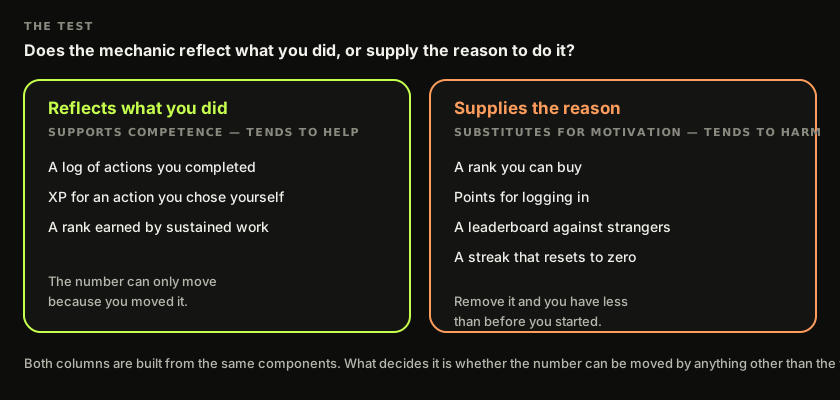
The pattern: mechanics that reflect what you did tend to help. Mechanics that supply a reason to do it tend to hollow out the reason you had.
What this means in practice
Three rules follow, and they’re the ones we designed around.
1. The score must be a record, not a currency. If you can obtain the number any way other than doing the work, the number stops measuring the work. This is the whole argument against buyable progression — a rank that arrives by payment is not evidence of anything, which makes it identical to the appearance scores we argue against elsewhere: a number you didn’t move by acting.
2. You have to pick the actions. A quest system that assigns you goals you didn’t choose is running on someone else’s autonomy. The useful version proposes actions in the area you’re avoiding and lets you decline them. The distinction sounds small and is not.
3. Design for the day the novelty dies. Since the literature says a chunk of the early effect is novelty, the mechanics that matter are the ones still standing in month three: an accurate log, a minimum small enough to survive a bad day, and a record you can’t argue with. Those aren’t game mechanics at all — they’re the same four components discipline is made of, with a scoreboard drawn on top.
Two effects worth borrowing
Not everything from behavioural research is a warning. Two findings are directly useful and don’t carry the reward trap.
Temporal landmarks. Dai, Milkman and Riis found that people are measurably more likely to pursue aspirational behaviour right after a date that feels like a fresh start — a birthday, a Monday, the start of a semester (Management Science, 60(10), 2563–2582). They called it the fresh start effect. This is the entire reason a winter arc with a stated start date outperforms “I should get in shape.” The date isn’t decoration; it’s the mechanism.
Implementation intentions. Gollwitzer’s work on if-then planning found that specifying when and where you will act substantially improves follow-through compared to holding the same goal without a plan (American Psychologist, 54(7), 493–503). “Train more” fails. “After I make coffee, I do the first set” is a different kind of object.
Both are cheap, and neither works by paying you.
So: does it work?
Qualified yes, and the qualification is the whole answer.
A game layer that makes accumulated effort visible, that you can only move by acting, and that tolerates a bad week without erasing your history — that’s a measurement instrument with a good interface, and measurement genuinely helps.
A game layer that supplies the motivation, punishes normal human variance, and can be advanced by paying — that’s a slot machine with a self-improvement skin, and the research suggests it leaves you worse off than not starting.
The uncomfortable part for anyone selling one of these: you can build either from the same components. Points, levels and streaks are not inherently one or the other. What decides it is whether the number can be moved by anything other than the work.
Source: Hamari, J., Koivisto, J., & Sarsa, H. (2014). Does Gamification Work? — A Literature Review of Empirical Studies on Gamification. Proceedings of the 47th Hawaii International Conference on System Sciences. https://doi.org/10.1109/HICSS.2014.377 · Deci, E. L., Koestner, R., & Ryan, R. M. (1999). A meta-analytic review of experiments examining the effects of extrinsic rewards on intrinsic motivation. Psychological Bulletin, 125(6), 627–668. https://doi.org/10.1037/0033-2909.125.6.627 · Dai, H., Milkman, K. L., & Riis, J. (2014). The Fresh Start Effect. Management Science, 60(10), 2563–2582. https://doi.org/10.1287/mnsc.2014.1901 · Gollwitzer, P. M. (1999). Implementation intentions: Strong effects of simple plans. American Psychologist, 54(7), 493–503. https://doi.org/10.1037/0003-066X.54.7.493
Solo Maxxing turns this into daily quests: five stats, XP, ranks E→S, and an AI coach that tells the truth. Get your rank →
Keep reading
Discipline vs motivation: why the people who 'have discipline' are just running better systems
Motivation is weather; discipline is architecture. The four mechanical parts — cues, minimums, friction, records — and how to build them from zero.
Why habit streaks fail — and the fix that isn't 'never miss a day'
Streaks work by loss aversion, then break for the same reason. Why a reset-to-zero counter punishes a harmless miss, and what to replace it with.
Monk Mode: what it actually is, and a 30-day protocol that isn't just deleting Instagram
Monk mode is subtraction with a target, not a vow of silence. What to cut, what to keep, the 30-day structure, and the three failure modes that kill most runs.