Why habit streaks fail — and the fix that isn't 'never miss a day'
Streaks fail because the mechanic that makes them powerful is the same one that makes them brittle. A streak works by loss aversion — you keep going to avoid losing the number. But a counter that resets to zero treats one missed day as total failure, when the evidence says a single miss costs you almost nothing. The fix is not more willpower. It’s a streak that tolerates a limited number of misses and shows them, so the number stays honest without becoming fragile.
Why do streaks work at all?
Because losing feels worse than gaining feels good.
That asymmetry is the core finding of prospect theory, published by Kahneman and Tversky in 1979 (Econometrica, 47(2), 263–291). People weight a loss more heavily than an equivalent gain. It’s one of the most replicated results in behavioural economics.
A streak converts an abstract, distant goal into a concrete thing you can lose today. “Get fitter over the next year” has no daily stakes. “Day 34” does. This is the only common self-improvement mechanic that recruits loss aversion in your favour, and it’s why streaks outperform plain to-do lists for daily habits.
Why do streaks break?
The same asymmetry, pointed the wrong way.
When the counter resets to zero, you don’t lose one day. You lose thirty-four. The felt cost of that single miss is enormous and completely disproportionate to the actual damage — and the research on what a miss actually costs is unambiguous.
Lally and colleagues tracked 96 people forming a daily habit over 12 weeks (European Journal of Social Psychology, 40(6), 998–1009). Two findings matter. Automaticity took a median of 66 days, with a range from 18 to 254 — so “21 days to a habit” is a myth. And critically: missing a single opportunity did not materially affect the habit-formation process.
One miss is noise. But a reset-to-zero counter tells you it was a catastrophe, and you believe the counter.
The abandonment spiral
Here’s the sequence, and it is remarkably consistent:
- You miss one day. Nothing has actually happened to the habit.
- The counter reads 0. Thirty-four days of evidence disappears from view.
- The remaining incentive to act today is gone — you can’t protect a streak you already lost.
- Rebuilding to 34 looks like five weeks of work for a number you had yesterday.
- You postpone the restart to a clean boundary. Monday. The 1st. Next month.
- The habit is now dead, having been killed by its own tracker.
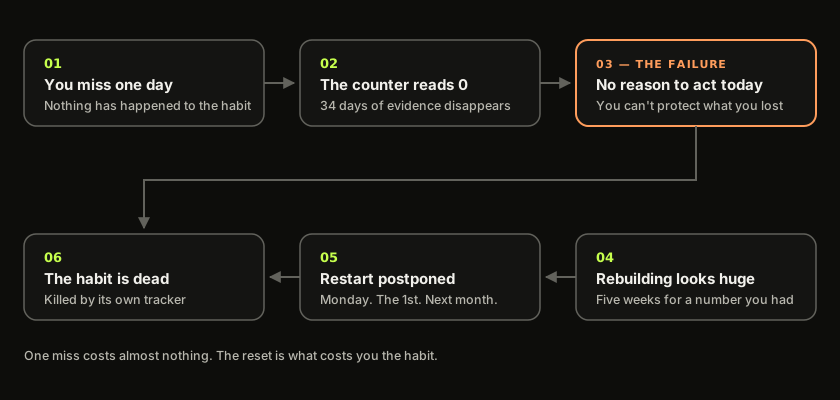
Step 3 is the mechanical failure. A well-designed system should make today’s action more attractive after a miss, not less. A reset counter does the opposite: it removes the only reason it ever gave you.
What a good streak looks like
Both extremes are useless. A streak that resets on any miss punishes normal life. A streak that forgives everything measures nothing. The working version sits between them.
| Design | What it does well | Where it fails |
|---|---|---|
| Reset to zero on any miss | Maximum daily pressure | One bad day erases all evidence and triggers abandonment |
| Never breaks, forgives silently | No abandonment spiral | The number stops meaning anything, so it stops motivating |
| Tolerates limited misses, shows them | Survives a bad Tuesday; stays honest | Requires you to define “limited” and hold the line |
Concretely, a streak worth keeping has four properties:
- A daily minimum small enough to survive your worst day. Roughly 20–30% of good-day capacity. Most “broken” streaks were never a discipline problem — the bar was set for a rested person. This is the single highest-leverage change, and it’s covered in full in discipline vs motivation.
- A tolerance, defined in advance. One or two misses per month absorbed without a reset. Decided when you’re calm, not negotiated at 11pm when you’re looking for a reason.
- Visible misses. The tolerance must not hide the miss. A streak that quietly forgives is lying to you, and a number you can’t trust does no work.
- Never miss twice. One miss is noise; two consecutive misses is a new pattern establishing itself. This single rule does more than any amount of trying to feel motivated.
The “never miss twice” rule, precisely
It’s worth stating exactly, because people soften it into uselessness.
The rule is not “try not to miss twice.” It’s that the day after a miss is non-negotiable, and it runs at the survival minimum if that’s what it takes. Not the full session. The floor.
This works because it attacks the actual failure point. Nobody’s habit dies from one skipped Tuesday. It dies in the four days after, when Tuesday’s skip has quietly become the new default and no single day feels decisive enough to reverse it. Making day two mandatory means the pattern never gets to form.
What to do if you’ve already broken one
The instinct is to wait for a clean boundary. Resist it — with one caveat.
There is real evidence that fresh starts help: Dai, Milkman and Riis found people are measurably more likely to pursue aspirational behaviour just after a temporal landmark like a Monday or a birthday (Management Science, 60(10), 2563–2582). Fresh starts are genuinely motivating.
But that effect is for starting something new. It is not a licence to leave a working habit dormant for nine days waiting for the 1st. If you missed yesterday, the correct restart date is today, at the minimum version. Save the landmark for launching something you haven’t begun — which is exactly what a winter arc or a monk mode block is for.
The short version
- Streaks work through loss aversion, which is real and strong.
- Reset-to-zero turns that same force against you the first time life happens.
- One miss costs you essentially nothing. The story you tell yourself about it costs you the habit.
- Set a floor you can hit on your worst day, allow a defined number of misses without erasing history, keep the misses visible, and never miss twice.
A streak should be evidence of what you did, not a fragile object you’re afraid to touch. The moment protecting the number matters more than doing the work, the number has stopped measuring anything — which is the general trap in gamifying your life.
Source: Kahneman, D., & Tversky, A. (1979). Prospect Theory: An Analysis of Decision under Risk. Econometrica, 47(2), 263–291. https://doi.org/10.2307/1914185 · Lally, P., van Jaarsveld, C. H. M., Potts, H. W. W., & Wardle, J. (2010). How are habits formed: Modelling habit formation in the real world. European Journal of Social Psychology, 40(6), 998–1009. https://doi.org/10.1002/ejsp.674 · Dai, H., Milkman, K. L., & Riis, J. (2014). The Fresh Start Effect. Management Science, 60(10), 2563–2582. https://doi.org/10.1287/mnsc.2014.1901
Solo Maxxing turns this into daily quests: five stats, XP, ranks E→S, and an AI coach that tells the truth. Get your rank →
Keep reading
Discipline vs motivation: why the people who 'have discipline' are just running better systems
Motivation is weather; discipline is architecture. The four mechanical parts — cues, minimums, friction, records — and how to build them from zero.
Does gamifying your life actually work? What the research says about XP, streaks and ranks
Points and levels help in some conditions and backfire in others. The evidence on gamification, the effect that ruins it, and how to tell them apart.
How to build a morning routine that survives week 3
Most morning routines die around day 16, and it is rarely a discipline problem. What actually breaks — and a three-tier routine built to absorb a bad night.